

Compliance · October 2026
eBay FCC ID Requirement: What Online Sellers Need to Know
A federal rule now requires online marketplaces to show an FCC ID on wireless devices, and eBay has added the field. Here is what it means for your listings and what to do before the 2027 deadlines.
I once had a stack of Bluetooth speakers to sell. They were an older model made in China, the kind of thing that sat on a shelf at Walgreens around 2010. I listed them on Amazon like I had listed a thousand other things.
Amazon shut the listings down and blocked me from listing the speakers again. The speakers had no FCC ID, and Amazon requires one for anything that talks over Bluetooth. In all my years of selling, I had never thought about it once.
Now eBay has added an FCC ID field of its own, so a lot more sellers are about to have the same first run-in. On certain products, eBay asks you to enter an FCC ID, and on some of them you may not be able to finish the listing without one. This post explains what an FCC ID is, where the requirement came from, and what to do about it.
Key takeaways
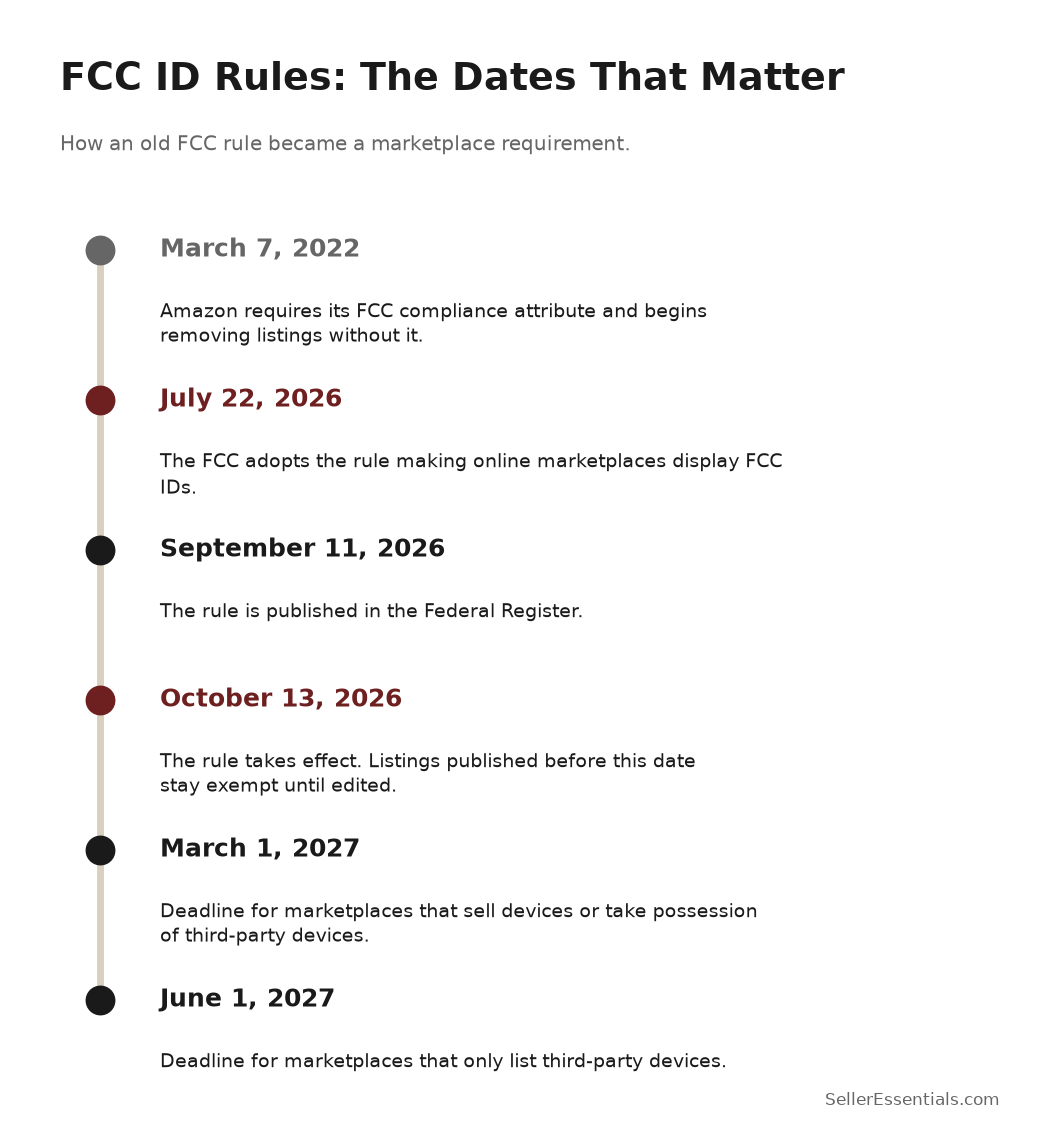
- The requirement comes from the FCC, not from eBay. A federal rule adopted July 22, 2026 requires online marketplaces to show an FCC ID on wireless devices. The rule’s effective date is October 13, 2026, and marketplace deadlines are March 1 and June 1, 2027.
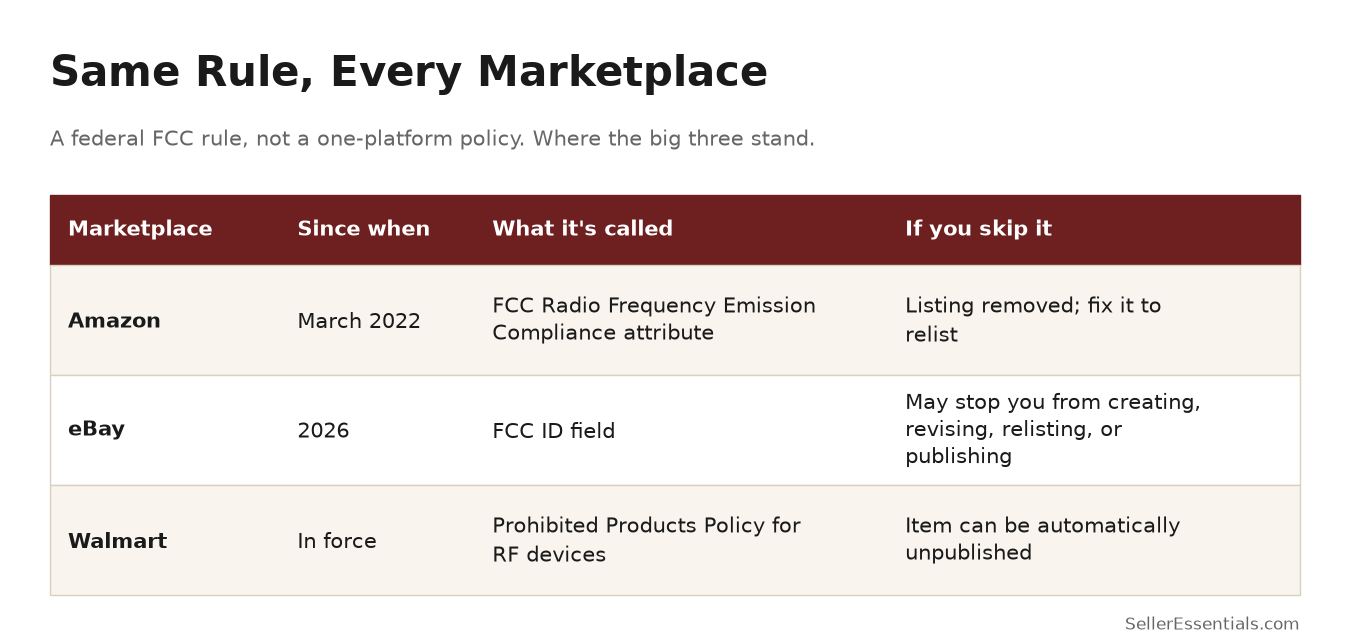
- Amazon has required FCC compliance information since March 2022, and Walmart prohibits unauthorized wireless devices. eBay is the latest of the three to add a field.
- For most sellers, the likely cost is a blocked listing that you cannot relist, not a large fine.
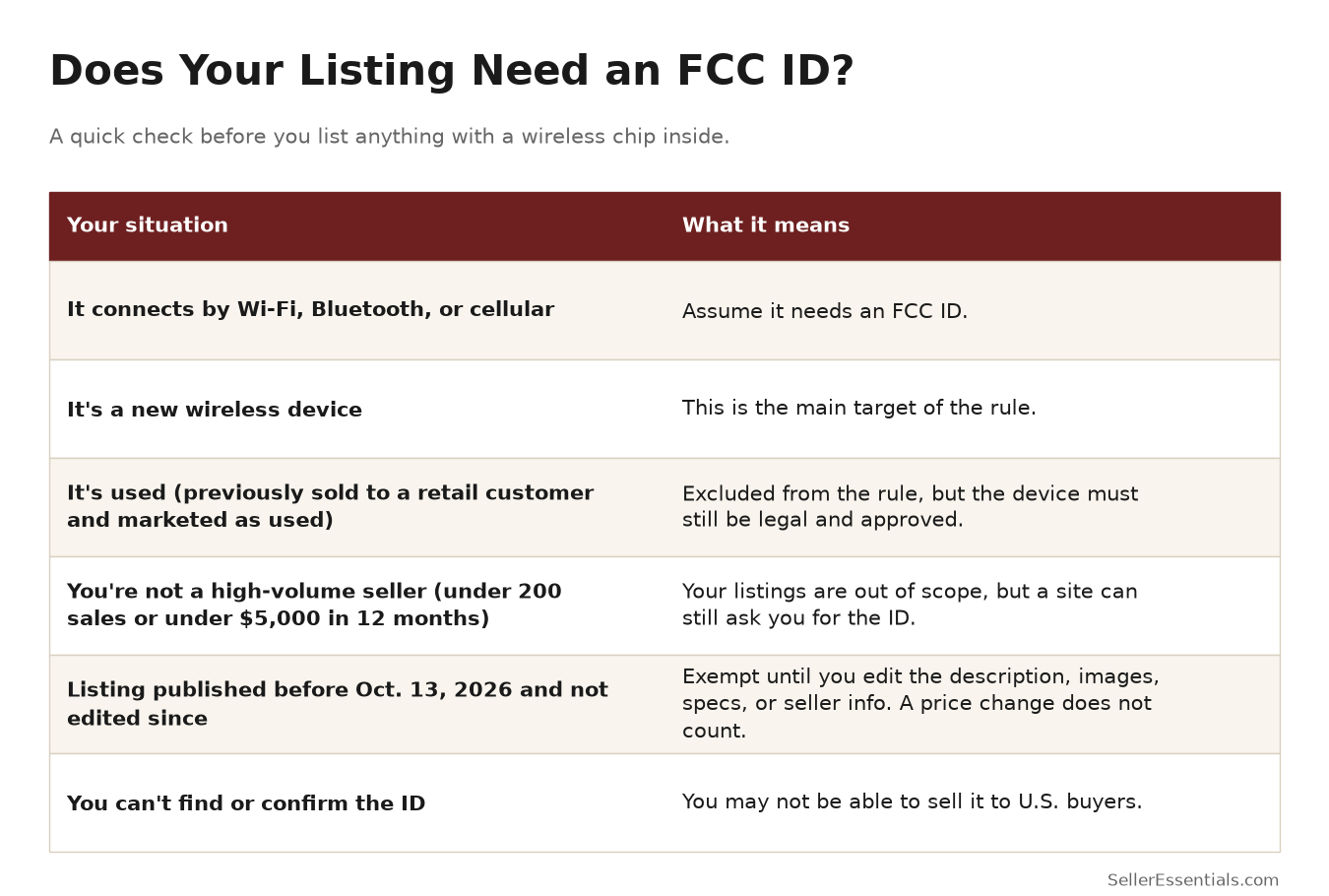
- Used items, sellers who are not high-volume, and listings published before October 13, 2026 and not edited since are outside the new rule. The device itself still has to be legal to sell, and a marketplace can ask for the ID anyway.
What an FCC ID is
An FCC ID is a code assigned to a wireless device after it has been tested and approved for sale in the United States. The FCC is the Federal Communications Commission, the agency in charge of the airwaves. A company that builds a device that sends out a wireless signal gets it tested, and if it passes, the FCC assigns an ID.
The ID is proof the device is cleared for sale here. It is separate from the model number, the serial number, and the UPC barcode. You will usually see it printed as the words “FCC ID” followed by a string of letters and numbers. eBay confirms that a model number, serial number, UPC, or IMEI cannot be entered in its place.
Products that intentionally send or receive a signal need FCC certification. If it has Wi-Fi, Bluetooth, or a cell connection, assume it needs an FCC ID. A small number of radio devices go through a different approval, called a supplier’s declaration of conformity, which has no FCC ID. Amazon’s compliance page lists both options. The products below commonly need an ID, according to eBay’s FCC ID page:
- Phones and tablets
- Laptops
- Wi-Fi routers
- Bluetooth devices, including speakers and earbuds
- Smartwatches
- Wireless cameras
- Drones
- Two-way radios
- Remote-control toys
My old speakers fell right into that list.
This did not start with eBay
Amazon, Walmart, and eBay now each have their own version of this requirement. A wireless device has always needed FCC approval before anyone could sell or import it in the United States. The new part is that online marketplaces must now show the proof on the listing.
Amazon began requiring an FCC Radio Frequency Emission Compliance attribute for radio devices on March 7, 2022, and removing listings that did not comply (TUV SUD). That is the rule that ended my speaker listings. Walmart’s prohibited products policy bans radio devices that are not FCC authorized, and Walmart can unpublish items that break its rules automatically. eBay has now added a field.
How the FCC rule reached your listings
The FCC changed who has to prove a device is approved. For years the burden sat with the companies that make the devices. In its Third Report and Order, adopted July 22, 2026, the FCC said that marketplaces listing wireless devices are marketing them, so marketplaces have to display the FCC ID at the point of sale. The order was published in the Federal Register on September 11, 2026, and its effective date is October 13, 2026.
The rule sets two compliance deadlines:
- March 1, 2027: marketplaces that sell devices themselves, or that have physical access to or take title to a third-party seller’s device, must display a valid and accurate FCC ID.
- June 1, 2027: marketplaces that list third-party devices without handling them must display a valid FCC ID. They must also take reasonable steps to check that the ID exists and require the seller to certify it is accurate.
eBay has not said which date applies to it. Its field is already live, so the rule shows up in your listing form before either deadline arrives. Because platforms carry the legal responsibility, they pass the work down to the people who create the listings, which is you.
Why the government cares
It is easy to write this off as more red tape, but a story from the shop next to mine changed my mind. The owner had spotty cell service, so he ordered a cheap signal booster online to help his phone work inside the store. It worked a little too well. One day some people showed up with equipment, driving around to find what was interfering with the local cell tower. The trail led to his shop and his new booster. They told him to take it out or he would be fined. It was another China-made device that had never been approved for use here.
Uncertified wireless gear can interfere with signals it is not supposed to touch, including cell networks and public safety radios. A booster like that is supposed to be FCC approved and registered with your carrier before you plug it in. Plenty of the cheap ones are neither.
There is one more layer that can catch a reseller who thinks they did everything right. The FCC keeps a Covered List of communications equipment it considers a national security risk, including certain telecom and video surveillance gear. Marketplaces such as Walmart prohibit Covered List products. A device can have an FCC ID and still be off limits if its approval was pulled or the brand is on that list. If you deal in cheap off-brand cameras, routers, or boosters, check before you buy.
What eBay’s notice does not cover
eBay’s notice is short and calm. Two things it leaves out are what happens if you ignore it, and who is exempt.
What happens if you skip it
FCC fines are real. In 2018, the FCC fined a large drone-gear seller about $2.86 million for marketing 65 models of uncertified transmitters (ARRL). That case involved a large operation that ignored warnings, and it is the ceiling, not the usual result.
For a typical seller the likely cost is a dead listing. eBay says that depending on the product and listing, you may be unable to create, revise, relist, or publish it, and listings missing the information may be hidden from buyers in the United States. If you cannot confirm the right FCC information for a product, you may be unable to sell it to U.S. buyers at all. That is what happened to my speakers on Amazon. eBay applies this to products sold to U.S. buyers wherever the seller is located.
Who is exempt
The rule excludes three kinds of listings, according to the rule text:
- Sellers who are not high-volume. The rule uses the INFORM Consumers Act definition, which generally means 200 or more sales and $5,000 or more in gross revenue in a 12-month period. Below that, your listings are out of scope.
- Used devices. The rule defines a used device as one previously sold to a retail customer and marketed as used or not new. Check how your own condition labels fit before assuming an item qualifies.
- Listings published before October 13, 2026. These stay exempt until they are amended, updated, or republished. Editing the description, images, specifications, or seller information counts as an update. Changing the price does not.
The exemption applies to the marketplace’s duty to display an ID. It does not make the device legal. The item still has to be an approved device, and a marketplace can choose to ask every seller for the ID to keep its process simple. eBay’s page lists no exemptions, so a used item or a small seller can still be prompted. Check how the field behaves in your own listing flow.
What to do if you sell anything wireless
None of this is hard, and it is easier to do before you list than after a block.
- Decide whether the item is a wireless device. If it has Wi-Fi, Bluetooth, or a cell connection, treat it as a yes.
- Find the FCC ID for that exact model. Check the label on the device, the box, and the manual. Many devices also show it in settings under Legal, Regulatory, or About. The maker’s website is another place to look. “Contains FCC ID” means an approved wireless part is inside, and that is the number to use.
- Match it to the exact product. Do not borrow an ID from a similar item or another model. A small change in the device can mean a different ID.
- Confirm the ID is real. The FCC has a free FCC ID search tool where you can type in the ID and see whether it exists.
- Ask the maker or supplier if you cannot find one. If there is still nothing, you probably cannot sell that item to U.S. buyers. It is better to learn that before you list.
- Add the ID before you relist a blocked item. Pressing relist alone does not fix it.
- Check before you edit an old listing. An edit to the description, images, or specs after October 13, 2026 can bring a listing under the new rule.
- Check price before you buy a pile of wireless cameras or boosters to resell. If an off-brand price looks too good to be true, check the brand and ID first. This matters most if you source electronics through online arbitrage.
Get your FCC IDs lined up before your marketplace’s deadline and you will not lose listings over this the way I did.
The bottom line
Marketplaces are tightening up and passing the work to sellers. Amazon did it in 2022, eBay has now added its field, and Walmart already prohibits unauthorized devices. If you sell anything with a wireless chip in it, the FCC ID is part of the listing, like a title and a photo. A little prep now costs less than a blocked listing later.
Frequently asked questions
Does every item I sell need an FCC ID?
No. Only wireless devices need one. If an item uses Wi-Fi, Bluetooth, or a cell connection, it likely does. A plain non-wireless item does not.
Is this an eBay rule?
No. It comes from a federal FCC rule that applies to online marketplaces. eBay added a field, and Amazon and Walmart already have their own versions.
What happens if I leave the FCC ID blank?
Depending on the item, you may be unable to create, revise, relist, or publish the listing, and it can be hidden from U.S. buyers. A blocked listing is the likely outcome, not a fine.
I only sell used items. Am I exempt?
The rule excludes used devices, meaning ones previously sold to a retail customer and marketed as used or not new. The device must still be a legal, approved device, and eBay’s page lists no exemption, so the site may still ask you for the ID.
Am I a small seller under the rule?
Probably, if you made fewer than 200 sales or earned less than $5,000 in the past 12 months. The rule uses the INFORM Consumers Act definition of a high-volume seller, which means 200 or more sales and $5,000 or more in gross revenue in a 12-month period. A marketplace can still ask you for the ID.
Do my existing listings need an FCC ID?
Listings published before October 13, 2026 are exempt until they are amended, updated, or republished. Editing the description, images, specs, or seller information counts as an update. A price change does not.
I ship from outside the United States. Does this apply to me?
Yes, if you sell to U.S. buyers. eBay says the FCC requirements apply to covered products marketed or imported into the U.S. regardless of where the seller or item is located.
Where do I find an FCC ID?
On the device label, the box, the manual, or in the device settings under Legal or Regulatory. You can also search the free FCC database.
Can I use the model number or UPC instead?
No. The FCC ID is a separate code, and eBay does not accept a model number, serial number, UPC, or IMEI in its place.
Can a device be banned even if it has an FCC ID?
Yes. If the approval was pulled or the brand is on the FCC’s Covered List, the device can still be off limits to sell.
Seller Essentials Blog
More Marketplace Updates for Online Sellers
FCC ID rules are one of several marketplace changes that affect how sellers list and ship products. The Seller Essentials blog covers Amazon fee and policy updates, shipping and carrier changes, and practical guides for online sellers.
About the author

Cite this article
Purdy, G. (October 7, 2026). eBay FCC ID Requirement: What Online Sellers Need to Know. Seller Essentials. https://selleressentials.com/ebay-fcc-id-requirement/
Sources
eBay Seller Center: FCC ID requirements · Federal Register: Third Report and Order on marketplace FCC ID display (ET Docket 21-232) · FCC: What is an RF device · FCC: FCC ID search · Amazon Seller Central: FCC Radio Frequency Emission Compliance attribute · TUV SUD: Amazon radio frequency emission policy history · Walmart Marketplace Learn: Electronics and radio frequency devices policy · ARRL: FCC fines HobbyKing for unauthorized drone transmitters · FCC: Covered List
Advertisement
