

Shipping Updates · October 2026
EU Product Identifiers Start November 1: New Rules for Shipping to Europe
Starting November 1, 2026, EU customs needs three product codes on consumer orders shipped there, and a new €2 fee begins. Here is what changes, what it costs, and how to get ready.
If you sell to customers in Europe, the way you ship to them changes on November 1, 2026. From that date, every consumer order headed to a European Union buyer needs a set of product codes in its shipping and customs data. Leave them off, and the package can be held at customs, delayed, or sent back to you.
The codes are one part of a bigger change in how Europe handles low-value packages from other countries. This guide explains what is happening in plain English, what it costs, how it works when you buy shipping through Amazon or eBay, and what it means for you even if you have never sold outside the United States.
Key takeaways
- From November 1, 2026, consumer orders shipped into the EU need product codes in the customs data: your item number and the maker’s number on every product, plus the barcode number if the product has one.
- Missing codes can mean held, delayed, or returned packages. Some carrier label tools, including FedEx’s, will not create a label without them.
- On July 1, 2026, the EU ended duty-free entry for orders worth €150 (about $170) or less and added a temporary €3 duty per type of item. From November 1, 2026, a €2 handling fee per item applies on top of that.
- If you buy shipping through Amazon, eBay, or USPS, the platform or carrier files the customs paperwork, but it still needs accurate product data from you.
- The US suspended its own $800 duty-free rule on August 29, 2025. Both markets have moved away from duty-free small parcels.
What’s actually changing
Europe now asks for three product codes on every consumer order shipped into the EU from outside it: your own item number, a number from whoever makes the product, and the barcode number if the item has one. Adding them is voluntary from July 1 through October 31, 2026, and required from November 1, 2026.
The rule covers sales to consumers. Orders shipped to EU businesses with a VAT number, and private person-to-person sales, are outside it. The codes do not go on the product itself. They go into the customs data that travels with the shipment, usually through the fields on your label or customs form.
Because this is EU law, it applies whichever platform you sell on and whichever carrier delivers the package. The carrier or platform usually files the customs entry, but it can only send the codes you give it. Each carrier and platform collects them a little differently.
The bigger change behind the codes
The codes arrived alongside a change in what it costs to send cheap goods into Europe.
For years, many countries used a rule called “de minimis.” It is an old Latin term, but the idea is simple: if a package is cheap enough, it comes in without customs duty. It kept customs from spending time on a $12 phone case.
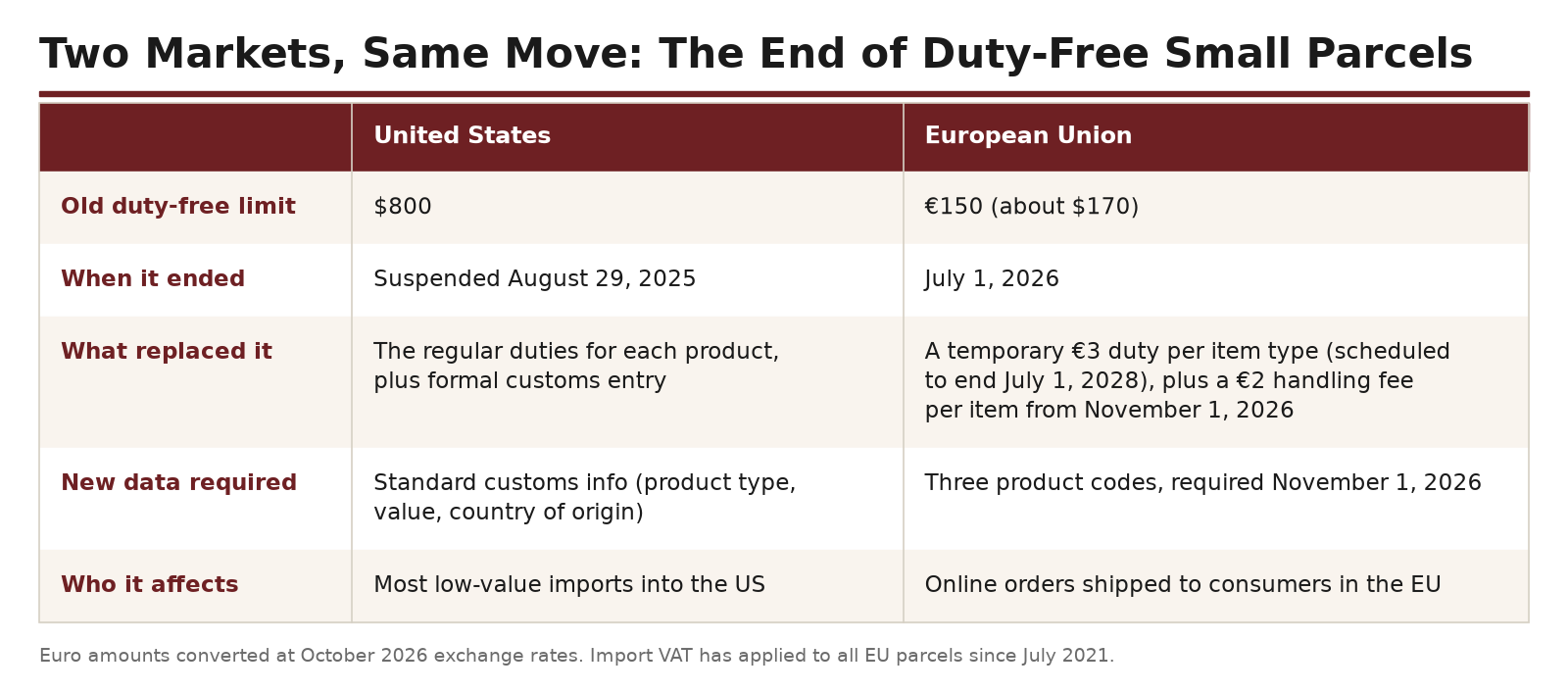
Europe’s cutoff was 150 euros, about $170 at October 2026 exchange rates. Packages under that amount entered without customs duty. They were never fully tax-free, because import VAT (Europe’s sales tax) has applied to every package since July 2021.
The €150 duty exemption ended on July 1, 2026. In its place, the EU charges a flat €3 customs duty, about $3.40, on each item in a consumer order worth €150 or less. An “item” here means a type of product, not each unit. Five T-shirts in one order count as one item and pay €3. Three T-shirts and a watch count as two items and pay €6. The €3 duty is temporary and is scheduled to run until July 1, 2028, when regular duty rates are due to take over.
From November 1, 2026, a second charge applies: a €2 handling fee per item, counted the same way. The handling fee covers every consumer order shipped into the EU, including orders over €150, and it is permanent. Carriers also add their own fees for processing duties.
The product codes come from the same set of EU rules. Their stated purpose is to help customs identify exactly what is in each box, so officers can spot unsafe or non-compliant products and apply one check to every identical product.
The same thing already happened here
Many American sellers tune out when they hear “European Union.” The US made the same move first.
The US had a much higher duty-free cutoff of $800. On August 29, 2025, the US suspended it for packages from every country (China and Hong Kong lost it earlier, in May 2025). Low-value imports into the US now pay the duties that apply to them and go through formal customs entry, including packages sent by mail. The law that created the $800 exemption is repealed effective July 1, 2027.
The US and Europe have reached the same decision. Cheap little packages no longer cross either border without duty and with little scrutiny. If you buy inventory from overseas, or sell to buyers overseas, these changes affect you in both directions.
“Cheap little packages no longer cross either border without duty and with little scrutiny.”
The dates that matter
These are the dates to keep straight.
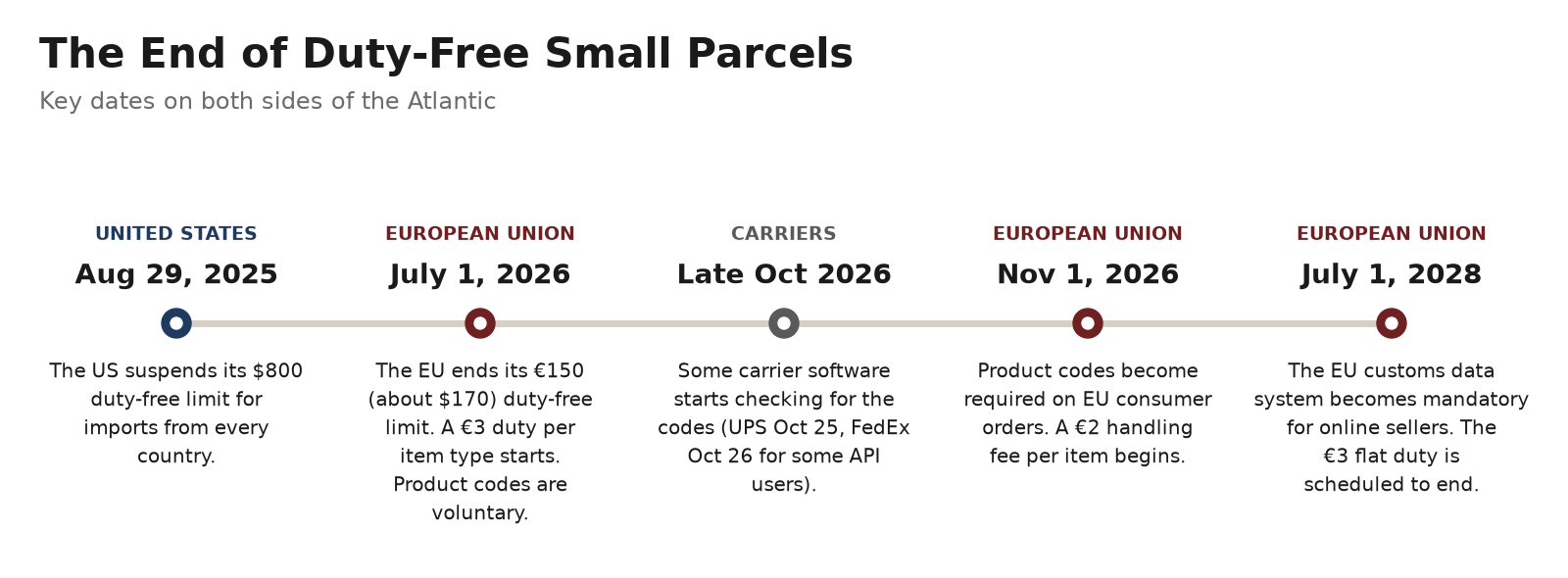
- August 29, 2025: The US suspends its $800 duty-free limit for all countries.
- July 1, 2026: The EU ends its €150 duty-free limit and starts the €3 duty per item type. Product codes can be added voluntarily.
- Late October 2026: Some carrier software starts checking for the codes before the legal deadline. UPS checks start October 25, 2026, and FedEx checks start October 26, 2026, for some customers who connect through its API.
- November 1, 2026: Product codes become required on EU consumer orders, and the €2 handling fee begins.
- July 1, 2028: The EU’s new customs data system becomes mandatory for online sellers, and the €3 flat duty is scheduled to end.
November 1 also falls inside the USPS holiday pricing period, so sellers shipping their own orders face the USPS holiday price increase and the new EU charges at the same time.
The three codes in plain English: M-PID, NS-PID and S-PID
The three codes have official EU names: the merchant product identifier (M-PID), the non-standardized manufacturer product identifier (NS-PID), and the standardized manufacturer product identifier (S-PID). Here is what each one means.
Your item number (M-PID). This is the number your selling platform or store uses for the product. On eBay, it is the eBay listing ID. On Amazon, Amazon asks sellers to give carriers the ASIN. On your own website, it is usually your SKU. You already have this one.
The maker’s number (NS-PID). This is the code the company that makes the product uses, such as a model number or manufacturer part number (MPN). Think of the part number printed on a box of printer ink. You can usually find it on the packaging, in the product listing, or on the maker’s website. If you sell your own private-label brand, you are the manufacturer for this purpose, so you assign the number yourself. A simple, consistent style or model code for each product works.
The barcode number (S-PID). This is the UPC, EAN, GTIN, or ISBN: the row of digits under the barcode. Most branded retail products have one, and a barcode scanner reads it faster and more accurately than typing it. If your product has no barcode, carriers ask you to enter “NO” instead of leaving the field blank.
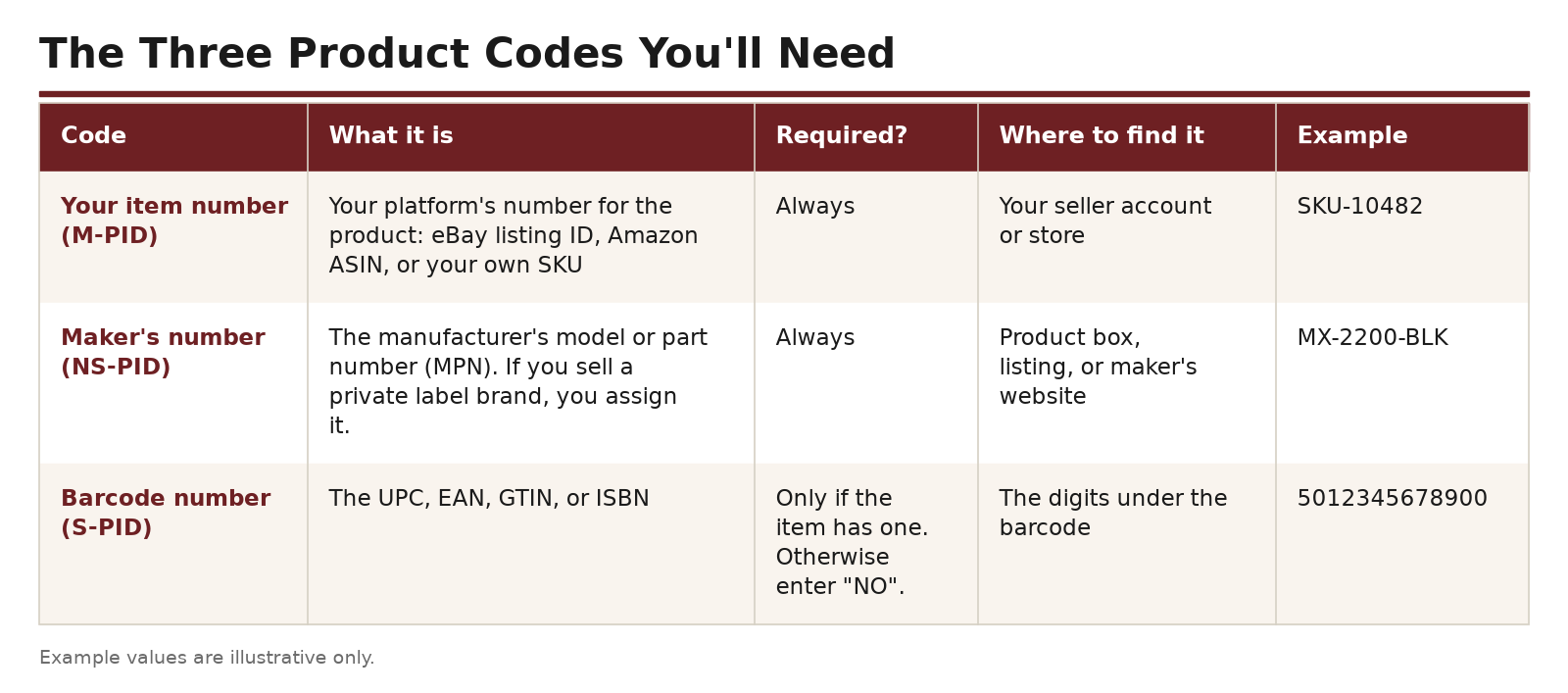
Your item number and the maker’s number are always required. The barcode is required only when the product has one. If you sell branded goods with real barcodes, you probably have most of what you need. The code that trips sellers up is the maker’s number, because many never tracked it.
A few product types get special treatment. Handmade goods, antiques, collectibles, art, stamps, and coins get some leeway from the EU on how the codes are filled in. Custom, personalized, print-on-demand, used, and refurbished items do not. For those, use the codes of the original product they are based on. The codes describe a product model or variant, not each individual unit.
If you buy shipping on Amazon, eBay, or Walmart
Most sellers who reach EU buyers do it through a marketplace and buy their labels there, often with USPS handling the international leg. Here is how the new rules fit each route.
Amazon. For seller-fulfilled orders shipped from outside the EU to EU customers, Amazon requires sellers to use an Amazon-approved carrier, give that carrier each product’s ASIN and Amazon’s import tax number, and ship duty-paid so the customer is never billed after checkout. Amazon’s Buy Shipping offers labels from a US address to Germany, France, Italy, Spain, the Netherlands, Poland, and Sweden (plus the UK, which is outside the EU) through an approved carrier, for orders under €150. Amazon’s notices focus on the ASIN and do not describe the other two codes, so keep each product’s maker’s number and barcode ready in case the label screen or carrier asks. For orders Amazon ships for you through FBA, Amazon prepares the shipment, and your part is accurate product data in your listings.
eBay. If you use eBay International Shipping, you send the package to eBay’s US hub and eBay handles the customs paperwork. eBay asks sellers to add manufacturer part numbers and barcodes to their listings so items stay visible to EU buyers. If you ship the order yourself, including with eBay labels, or use SpeedPak, eBay says you must give the codes to your carrier or risk delivery delays.
Walmart. Walmart’s US marketplace sells to US customers, so Walmart.com orders do not ship to the EU and this rule does not touch them.
USPS. When you buy a USPS international label through Click-N-Ship, a post office counter, or the label tools that connect to USPS, the system reads your item descriptions to assign each item a tariff code and calculate the €3 duty per item type. Clear, specific descriptions matter. USPS lets business shippers prepay the duty, VAT, and fees (called Delivered Duty Paid) for supported EU countries on First-Class Package International, Priority Mail International, and Priority Mail Express International. For some destinations, prepayment may be required to buy postage. If you do not prepay, your buyer pays before the package is released. As of October 2026, the USPS page on EU duties explained the €3 duty but did not describe the product code fields, so check your label screen before your first EU order.
What happens if you skip it
“Add some codes” sounds minor until a shipment gets stuck. When the codes are missing or wrong, these are the likely results.
Your package can get stopped. Carriers warn that packages without the codes can be held, delayed, inspected, or returned. FedEx says that from November 1, 2026, you cannot create a label in FedEx Ship Manager or through its API without them. UPS says shipments missing the codes may be delayed, returned, or charged a Pre-Release Notification Fee.
There can be penalties. Each EU country sets its own penalties for wrong or missing customs information. The EU’s new customs code, which takes effect in September 2027, adds fines for online sellers who repeatedly get it wrong.
Someone has to pay the duty, and it might be your buyer. The business that files the customs entry owes the duty and handling fee. If you ship without prepaying (often called DAP or “delivered at place”), the carrier can bill your buyer at the door for duty, VAT, and its own processing fees before handing over the box. Some buyers refuse the package at that point, which leaves you with a return, a refund, and an unhappy customer. Shipping duty-paid avoids that, and Amazon requires it for seller-fulfilled EU orders.
Where this is heading
The EU describes the product codes as a first step toward more complete product data at the border. On July 1, 2028, its new EU Customs Data Hub becomes mandatory for online sellers, and platforms and sellers become the legal importer for the goods they sell to EU consumers.
The EU is also building a Digital Product Passport for certain product groups, starting with batteries. It is a separate law with its own timeline.
You do not need to act on 2028 today, but the direction is clear. Accurate product codes for every product model are becoming a standing part of selling across borders.
What to do
What you need to do depends on where your customers are.
If you only sell to customers in the United States, the EU rule does not affect your listings. Keep the US change in mind if you buy inventory from overseas, because importing into the US got more expensive and required more paperwork starting in August 2025.
If you sell to customers in Europe, work through this list:
- Gather the three codes for each product you might ship to the EU: your item number, the maker’s number, and the barcode (or “NO” if there is none). Start with the maker’s number, since it is the one most sellers are missing.
- Add the maker’s number and barcode to your listings. eBay uses them to keep items visible to EU buyers, and they give your carrier or platform what it needs.
- Check the label screen you use. Whether you buy labels through Amazon Buy Shipping, eBay, USPS, or a carrier directly, find where it asks for the codes and run a test order to an EU address.
- Write clear item descriptions. USPS uses them to assign tariff codes and calculate the duty.
- Decide who pays the duty. Shipping duty-paid protects your buyer from a bill at the door. Amazon requires it for seller-fulfilled EU orders.
- Update your prices or shipping charges. Budget €3 per item type on orders of €150 or less, €2 per item on every order, and your carrier’s fees.
- If someone else packs and ships your orders, confirm that your merchant-fulfilled prep service passes the codes through on each EU order.
- Follow each platform’s own instructions. The law is the same across the EU, but every platform and carrier has its own steps for entering the data.
None of this is hard once your product data is in order. The sellers who run into trouble are the ones who find out a number was missing when a package comes back.
Frequently asked questions
Do I need to worry about this if I only sell in the United States?
No. The rule covers packages going to consumers in the European Union. If you never ship to Europe, your listings are fine. If you import inventory from overseas suppliers, though, importing into the US has cost more and required more paperwork since August 2025.
What are M-PID, NS-PID and S-PID?
They are the EU’s official names for the three codes. The M-PID is your item number (eBay listing ID, Amazon ASIN, or your SKU). The NS-PID is the manufacturer’s model or part number. The S-PID is the barcode number, such as a UPC or EAN. The first two are always required, and the third is required when the product has one.
Is the €3 duty charged per item or per package?
Per type of item. Goods in one order that share the same tariff classification count as one item, whatever the quantity. Five T-shirts pay €3; three T-shirts and a watch pay €6. The €3 applies to consumer orders worth €150 or less. The separate €2 handling fee is counted the same way and applies at any order value.
Is there a value limit on the product code rule?
Sources disagree. The European Commission’s October 2026 guidance limits the code requirement to orders of €150 or less, while eBay and the major carriers ask for the codes on every EU consumer order regardless of value. The simplest approach is to include them on every EU order.
Who pays the €3 duty and the €2 handling fee?
Officially, the business that files the customs entry, which is usually the platform, the carrier, or you through your carrier. In practice, if the duty is not prepaid, the carrier can ask your customer to pay it, plus VAT and a carrier fee, before handing over the box. That often ends in a refused package, so decide how the duty gets paid before you ship.
eBay sent me a notice about EU product identifiers. What do I need to do?
Add the manufacturer part number and barcode to your listings where they exist. Your eBay listing ID already serves as your item number. If you use eBay International Shipping, eBay handles the customs paperwork from its US hub. If you ship EU orders yourself or use SpeedPak, give the codes to your carrier.
My product has no barcode. What do I enter?
Enter “NO” in the barcode field instead of leaving it blank. You still need your item number and a maker’s number. If you sell your own private-label brand, you are the manufacturer, so create a consistent model code for each product. Used, refurbished, and personalized items use the codes of the original product.
I sell branded products with barcodes. Am I already covered?
Mostly. The barcode covers one code and your own item number covers another. The piece most sellers are missing is the maker’s number, the manufacturer’s own model or part number. Track it down for each product you ship to the EU.
What’s a GTIN, and is it the same as a UPC?
They are the same idea: a standard barcode number that identifies a product worldwide. GTIN is the umbrella term. A UPC is the 12-digit version common in North America, and an EAN is the 13-digit version used in most other countries. If your product has a barcode, the number under it is the barcode code (S-PID) Europe asks for.
Seller Essentials Blog
More shipping and policy updates for sellers
EU product codes are one of several shipping and compliance changes affecting sellers who fulfill their own orders. The Seller Essentials blog covers USPS price and fee changes, Amazon fulfillment updates, and practical guides for running an online selling business.
About the author

Cite this article
Purdy, G. (October 7, 2026). EU Product Identifiers Start November 1: New Rules for Shipping to Europe. Seller Essentials. https://selleressentials.com/eu-product-identifiers-november-2026/
Sources
European Commission: Guidance on the temporary EUR 3 customs duty and the Union handling fee (Oct. 2026) · European Commission: EU customs reform · European Commission: The EUR 3 customs duty on low-value parcels · European Commission: Guidance and legal text on the temporary flat duty · EU Publications Office: Council Regulation (EU) 2026/382 · European Parliament: New e-commerce and customs rules adopted · FedEx: EU product identifier guide · UPS: EU de minimis changes · DHL: EU product identifiers · USPS: Prepaid import duties · eBay: EU product identifier requirements · Amazon Seller Central: EU customs requirements for low-value imports · Amazon Seller Central: Ship from the US with Buy Shipping · White House: Suspending duty-free de minimis treatment for all countries · U.S. Customs and Border Protection: De minimis guidance · GS1 US: What is a GTIN?
Advertisement
